
Electricity is a fun topic to explore in science classrooms. Static Electricity gives a fun affordable display of how the forces are working in static electricity. The lesson can be as foundational as an understanding of charges, or it can be detailed to utilizing the formula of coloumbs law. I’ve written some foundational pieces of information about how to teach a lesson of static electricity or coulomb’s law.
The video below is a demo of a lesson done with students on static electricity. The example uses few affordable materials listed in the video description. It is magical to the students and gives a great example also of the intensity of charging items.
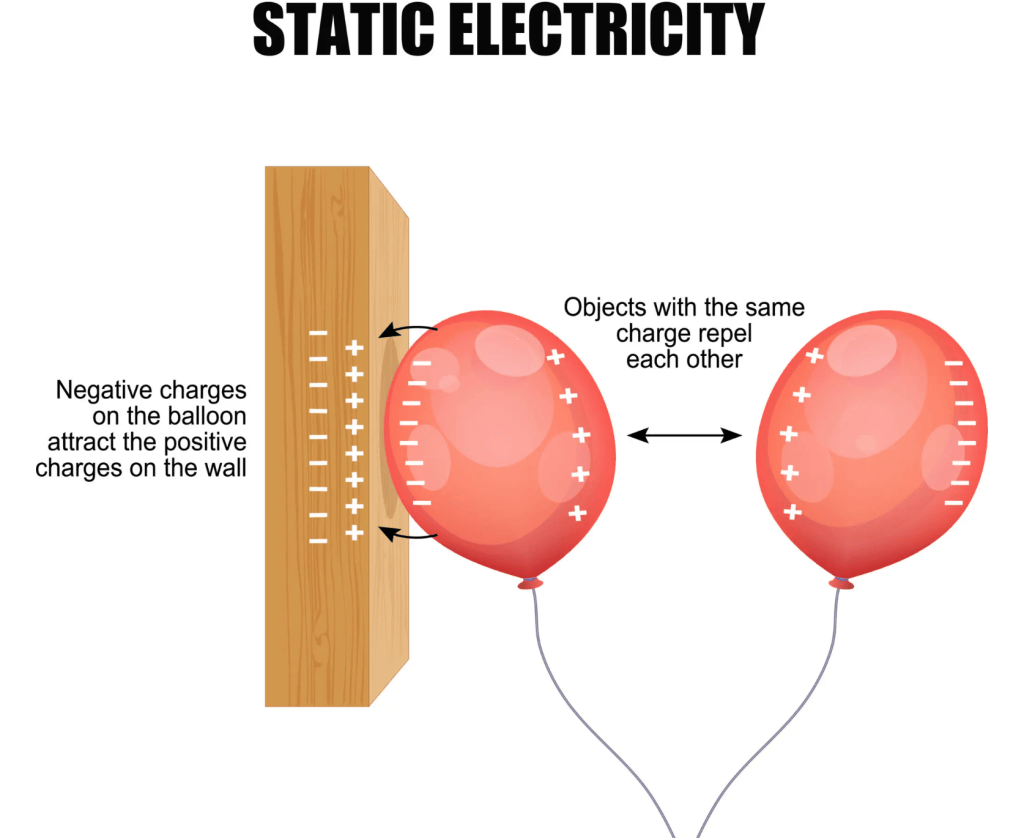
Charges – Positive and Negative charges are a prime example in the activity. Like charges repel and opposite charges attract. The charges become more or less dominant depending on the intensity of the charge.
Position of Charges – The primary charge varies depending on the material, and the amount of charge depends on the strength or time used in charging the object. For example, when a balloon is rubbed against a persons hair there is a dispersion of charges. The balloon keeps a negative charge and a positive charge is on the persons hair. If you were to place the balloon near a white board ,because of the positive and negative charges on the white board, the balloon will stick to the surface.
Coulomb’s Law – Coulomb’s law is the a calculation of static energy. The equation for coulomb’s law is E=kq1q2/r^2. The equilibrium constant is represented by k is 8.9 x 10^9 N and the q is the charge of the particles, r is the distance between the charges. There are several online simulations to learn and teach coulomb’s law. A great lab example to practice calculating electric force is charging a balloon and placing it over small pieces of paper.

Below is a practice problem of using coulomb’s law:
A negative charge of – 2.0 C and a positive charge of 3.0 C are separated by 80 m. What is the force between the two charges?
E = kq2q1 / r^2
E = 8.99 x 10^ 9 Nm^2/C^2 (-2.0 C) (3.0 C) / 80 m ^ 2
E = – 54 x 10 ^ 9 Nm^2 / 80 m ^ 2
E = – 54 x 10 ^ 9 Nm^2 / 6400 m
E = – 8.3 x 10^6 N


Leave a comment