
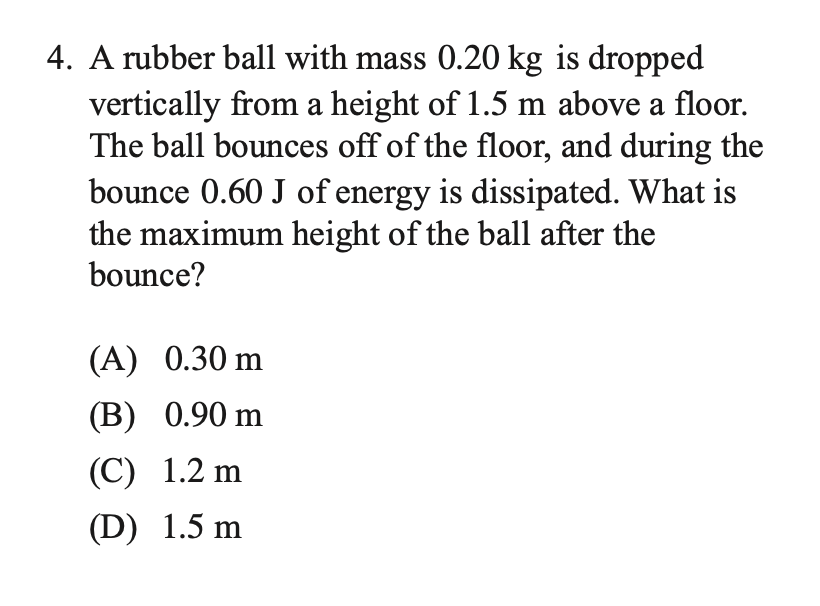
This is a practice problem from an AP Physics practice test. This particular problem is concerning potential energy, and utilizes basic algebra. The equation is use of multiplication and division, but the challenge sits in using the correct equation and identifying the variables. The question asks for the final height of a ball after the ball bounces, as well as the amount of energy dissipated. Final height and energy would require the use of potential energy equation.
In physics there are many factors we could consider like friction and elasticity when reading through this problem. However the correct formula to use is potential energy because the question specificially mentions the amount of energy dissipated and velocity is not considered. Also, all of the answers are of final height in requiring the units of meters. The formula to solve for this problem is U = mgh.
The formula for potential energy is U = mgh, where U = potential energy, m = mass, g = gravity, and h = height. The units for mass are in kilograms, gravity uses acceleration unitis (m/s^2), height is in meters, and energy is measure in Joules. Knowing that, you can plug the identified numbers into equation, and plug and chug. The answer to the problem will give the amount of height lost in the second bounce.
To find the maximum height the ball bounces after, we will take the answer and subtract from the initial height. Therefore the correct answer to this problem is C. 1.2 m.
U = m x g x h
U = potential energy (J) m = mass (kg) g = gravity (10 m/s^2) h = height (m)
.60 J = .20 kg x 10 m/s^2 x (h)
.60 J = 2 kg x m/s^2 x (h)
.30 m = h
1.5 m – .3 m = 1.2 m


Leave a Reply